1. Introduction: LLP compliance in India
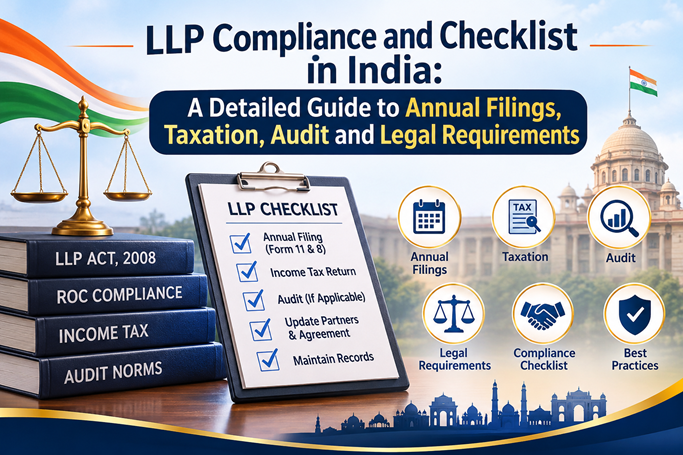
A Limited Liability Partnership (LLP) is a business structure that combines the operational flexibility of a partnership with the separate legal identity and limited liability protection of a corporation. LLP is a popular format for small business and professional consulting firms, as it has less compliance formalities in comparison with the Private Limited Company. Although registering an LLP is the first step of the legal responsibilities of an LLP. After incorporation, the LLP is required to maintain proper financial records, provide prescribed information to the Ministry of Corporate Affairs (MCA), file income tax returns and comply with other laws applicable to their activities. These duties are collectively known as LLP compliance.
LLP compliance is more than simply completing filing forms at the end of a financial year. It also includes reporting changes in partners, maintaining the LLP agreement, keeping track of tax payments, determining audit requirements and keeping business registrations up to date.
For example, an LLP providing professional consulting services may be required to maintain accounting records, file its annual MCA forms, file its income tax return and comply with applicable TDS provisions. In case its activities are covered under the ambit of GST Registration, it is also required to file the relevant GST Returns and pay tax within the stipulated timelines.
Likewise, an LLP that has not earned revenue or remained dormant during a particular financial year still have annual filing obligations. All LLP’s are required to file yearly annual compliance filing with MCA.
Knowing these requirements allows LLP partners to avoid missed deadlines, unnecessary additional fees and complications during financial transactions or business expansion.
2. What does LLP compliance mean?
LLP compliance is the process of meeting the legal, accounting, taxation and regulatory obligations applicable to a Limited Liability Partnership. The primary legislation governing an LLP is the Limited Liability Partnership Act, 2008 along with the applicable LLP rules. Other requirements arise from income tax legislation, GST law, labour legislation and sector specific regulations.
The exact rights or obligations of an LLP will depend on variables such as:
Its date of incorporation.The number of its partners and their status. Its capital contribution.
Its annual turnover and financial condition.
Whether it employs staff.
Whether it is registered under the GST.
Nature of payments to vendors, employees and professionals.
Whether it operates in a regulated industry.
Main categories for LLP compliance can be divided as follows:
| Category | What it’s all about | Instances |
| MCA compliance under LLP Act, 2008 and applicable LLP Rules | Reporting of prescribed information to the Registrar | Form 11 & Form 8 |
| Accounting adherence | Keeping accurate financial records | Statement of Accounts , bank reconciliations and ledgers |
| Compliance inspection | Determining the need for an audit and conducting an audit | Statutory audit of LLP and income tax audit read with the LLP Agreement |
| Compliance with income tax | Reporting Taxable Income and Paying Applicable Taxes | ITR 5 & Advance Tax |
| GST compliances | Where applicable: fulfilling indirect tax obligations | Tax Payments, Invoice Requirements and GST Returns |
| Compliance based on events | Reporting changes to the LLP’s structure or details w.r.t LLP Agreement | Changes of partners and changes of registered office and other details w.r.t LLP Agreement |
| Employment Law Compliance | Discharging relevant employee-related obligations | EPF, ESI , Labour Welfare fund and payroll requirements, as applicable |
| Conformity to the industry | Compliance with business-related regulations | Registration under Shops and Establishment Act, Factories Act, Industry specific Permits, licences and regulatory filings |
Each category must be considered separately, as satisfaction of one requirement does not ensure satisfaction of another.
3. Compliance of LLP with Regulatory Framework
LLP Compliance in India is governed by various Laws and regulatory bodies as detailed below.
3.1 The Limited Liability Partnership Act, 2008
LLP Act provides legal framework for formation, operation and closure of an LLP. It deals with matters such as the legal status of an LLP, the relationship between partners, the duties of the designated partner, contributions, financial disclosures, annual returns and penalties for non-compliance.
3.2 Rules of Limited Liability Partnership, 2009
The LLP Rules prescribe the practical requirements regarding forms, records, filing procedures, audit conditions and other statutory matters. The LLP shall observe the rules and amendments in force for the relevant period.
3.3 Corporate Affairs Ministry
The MCA administers the central LLP filing structure through its online systems. LLPs file prescribed information with the Registrar using the applicable electronic forms.
3.4 Income-tax Department
LLP has to work out its income tax liability, compute taxable income, pay the tax due and file the return as prescribed. ITR 5 is the return form of an LLP normally. Depending on the circumstances, other tax forms may also be required as well as audit reports.
3.5 Other regulators and GST authorities
An LLP required to be registered under GST shall comply with the relevant registration, return filing, payment and record keeping requirements. There may be additional obligations imposed by labour law, state law, licensing requirements or industry specific legislation.
4. Why LLP compliance matters?
Compliance protects the LLP’s legal and financial standing, and helps its partners to do business responsibly.
4.1 How to avoid extra fees and penalties?
Failure to file by a deadline may lead to additional filing fees, statutory penalties, interest or other consequences dependent on the default. Compliance calendar helps the LLP to complete the filings before due dates.
4.2 Maintenance of appropriate statutory records
The official records of the LLP should mention its real partners, registered office, terms of agreement and financial disclosures. Wrong or outdated information can cause problems during regulatory reviews, financing or business transactions.
4.3 Enhancing financial management
Regular bookkeeping helps partners to know revenue, expenses, outstanding payments, liabilities and profitability. It also helps in preparing financial statements and tax computations.
4.4 Underpinning business development
Banks, customers, lenders and prospective business partners may require financial statements, tax returns and proof of statutory compliance. Organised compliance history can help make these reviews more productive and also help access to better and organised credit facilities.
4.5 Reducing conflicts between partners
A well drafted LLP agreement lays down the manner of sharing profits, manner of making decisions and manner of dealing with changes in partners. That makes it less uncertain when the business grows or when things change.
5. Types of LLP Compliances
LLP compliance can be broadly classified into recurring obligations and obligations that arise out of specific events.
5.1. Annual Compliance
Annual compliance means obligations that recur within each financial year or reporting cycle. Like Form 11, filing of income tax return, preparation of financial statements and audit assessment, Form 8.
5.2 Event-based compliance
Event based compliance is when a certain change happens. Examples include appointment of a new partner, resignation of a designated partner, amendment of the LLP agreement or relocation of the registered office or filing of charge form with MCA for any secured loan availed by the LLP.
5.3 Compliance with tax
Tax compliance includes obligations of income tax, advance tax, TDS, TCS and GST wherever applicable. The requirements vary depending on the income, payments, transactions and registration status of the LLP.
5.4 Operational compliance
Operational compliance also covers other requirements arising from the LLP’s employees, premises, business licences or regulated activities. Not every LLP will have identical operational obligations.
6. LLP Compliance process flow chart in Table Format
The compliance process for a Limited Liability Partnership (LLP) in India involves maintaining statutory records, preparing statement of accounts, filing annual returns, meeting applicable tax obligations and updating the Ministry of Corporate Affairs (MCA) whenever required.
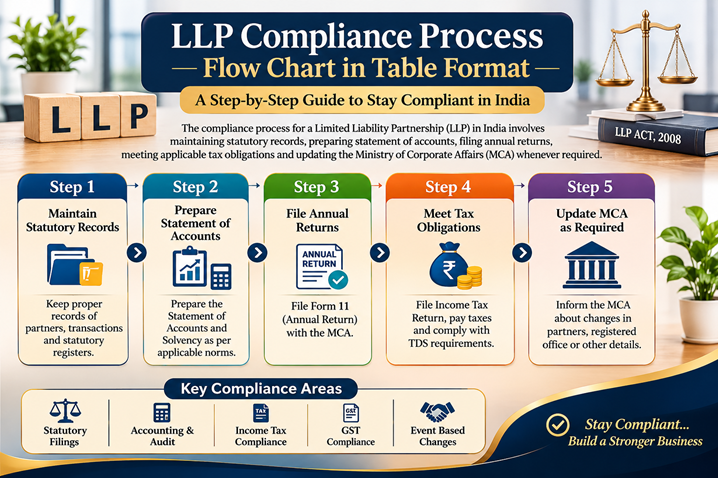
6.1. LLP Compliance Process Flow Chart
| Step | Compliance stage | Key activities | Relevant form or record |
| 1 | LLP Incorporation | Obtain the Certificate of Incorporation, LLP Identification Number and PAN. Complete applicable registrations, If required with Shops and Establishment Act, GST , ESI and EPF. | Certificate of Incorporation, PAN. GST registration. Shops and Establishment Act, Registration |
| 2 | Execute LLP Agreement | Prepare and execute the LLP Agreement specifying partners’ rights, duties, profit sharing and management responsibilities. | LLP Agreement to be carefully drafted covering the Partner duties, Responsibilities, Managing Partner , Designated Partner , Capital contribution and Profit sharing details. |
| 3 | File LLP Agreement | File the agreement with the MCA within the prescribed period. | Form 3, generally within 30 days of incorporation |
| 4 | Maintain Books of Accounts | Record income, expenses, assets, liabilities, capital contributions and business transactions. | Books of Accounts, Sec 24 of LLP Act, 2008 |
| 5 | Complete Periodic Tax Compliance | Review GST returns, TDS obligations, advance tax and other applicable tax requirements. | GST returns, TDS returns and tax challans, as applicable |
| 6 | Prepare Statement of accounts | Prepare the statement of account and solvency based on the LLP’s financial record. | Statement of Account and Solvency |
| 7 | File Annual Return | Report details of partners and the LLP’s management structure. | Form 11, generally due by 30 May |
| 8 | File Statement of Account and Solvency | Submit the LLP’s statement of account to the MCA. | Form 8, generally due by 30 October |
| 9 | File Income Tax Return | File the LLP’s income tax return and pay applicable taxes. | ITR-5, generally due by 31 July for non-audit cases, subject to applicable rules |
| 10 | Complete Audit, if Applicable | Arrange an audit of the accounts where the prescribed turnover or contribution criteria are met. | Auditor’s report and audited Statement of account , where applicable |
| 11 | Update Changes, if Any | Report changes in partners, designated partners, registered office or the LLP Agreement within applicable timelines. | Relevant MCA forms, including Forms 3 and 4 |
| 12 | Annual Compliance Review | Verify that all statutory filings, taxes, records and applicable registrations are up to date. | Compliance checklist and filing acknowledgements |
6.2. Annual LLP Compliance Calendar
| Month or deadline | Compliance requirement | Form | Applicability |
| 30 May | Annual Return | Form 11 | Every LLP |
| 30 October | Statement of Account and Solvency- to be filed Annually | Form 8 | Every LLP |
| 31 July or 31 August, as applicable | Income Tax Return | ITR-5 | Depends on the nature of income and applicable audit requirements |
| 31 October, generally | Income Tax Return for audit cases | ITR-5 | As per the Income Tax Act, due dates. (The due dates may vary every depending on the Income Tax Notifications) August 31 for non-Audit cases. Tax Audit Report: September 30, where Tax Audit is applicable. October 31st for Audit Cases November 30th , where Transfer pricing provisions are applicable. |
| Periodic deadlines | GST returns and TDS returns | Relevant GST and TDS forms | Where applicable |
| Within the prescribed period after a change | Report changes in partners or the LLP Agreement | Forms 3 and 4, as applicable | When relevant changes occur |
The Income Tax Department identifies ITR-5 as the applicable return form for LLPs. Tax return due dates depend on the applicable category and may be extended by government notification.
Important correction: For an LLP carrying on business or profession without a tax audit, the general due date listed for an Assessment Year is 31 August, not 31 July. Always verify the deadline applicable to the relevant assessment year.
6.3. LLP Compliance Documents Checklist
| Document or record | Purpose |
| Certificate of Incorporation | Proof of legal registration |
| LLP Agreement and amendments | Records the rights and obligations of partners |
| PAN and applicable GST registration | Tax identification and indirect tax compliance |
| Books of Accounts | Records financial transactions |
| Bank statements and supporting invoices | Supports accounting entries |
| Statement of Account and Solvency | Supports preparation and filing of Form 8 |
| Details of partners and designated partners | Supports preparation and filing of Form 11 |
| Audit report, if applicable | Supports statutory or tax audit compliance |
| Tax payment challans and filed returns | Evidence of tax compliance |
| MCA filing acknowledgements | Evidence that statutory forms have been submitted |
7. LLP Agreement Filing and Compliance Procedures
7.1 What is LLP agreement?
The LLP agreement is the main document that governs the relationship between the LLP and the partners, and the rights and responsibilities of the partners in relation to the LLP. It usually specifies:
- The contribution of each partner to the capital.
- The ratio of profit sharing.
- Partner’s duties and responsibilities
- The process of making decisions.
- The terms of remuneration and interest, if any.
- The process of taking on a new partner.
- Procedure for retirement or resignation.
- Capital account of a partner treatment.
- Dispute settlement procedures.
You can download a sample LLP Agreement here : LLP AGREEMENT SAMPLE
A well-written agreement avoids any misunderstanding as the partners have agreed terms to fall back on instead of informal arrangements.
7.2 Filing Form 3
Form 3 is for filing of the LLP agreement and any changes prescribed therein with the registrar. The original agreement must generally be filed within 30 days of incorporation. Any amendments to the agreement are also to be filed within the prescribed period applicable to the change.
Before filing, the LLP must ensure that the executed agreement states the agreed terms and the stamp duty requirements applicable have been met.
7.3 When should the LLP agreement be amended?
When new partner joins the LLP.
Partner retires or resigns.
Changes in capital contributions.
The profit-sharing ratio varies.
Partners alter their duties or powers to take decisions.
Change in remuneration or interest arrangements .
The partners agree to modify other material terms.
Example: An LLP has 2 partners and they share profits equally. Later, they agree to bring in a new partner who will receive 20% of the profits. The LLP should record the amended arrangement, update the agreement and complete the requisite statutory filings.
8. Filing of Annual Return in Form 11
8.1 What is Form 11?
Form 11 is an annual return filed by an LLP with the Registrar. It reports the prescribed information about the LLP and its partners including relevant changes during the financial year. This is a statutory disclosure and should not be confused with the LLP’s income tax return or Statement of account.
8.2 When to File Form 11?
The usual due date is 30 May annually. The filing is due 60 days after the end of the financial year on 31 March. This is normally by 30 May after the end of the financial year, unless an extension or special notification applies. For example, the annual return for the financial year ending 31 March 2026 is normally due by 30 May 2026.
8.3 Information needed for Form 11
The LLP will confirm that:
Its name and LLP identity particulars.
The particulars of partners and designated partners as at the date of present.
Details of Contribution.
Relevant changes in the year.
Required declarations and supporting information
Certification requirements that apply.
Such information must be consistent with the LLP agreement and other documents filed.
8.4 Do we need to file Form 11 if there is no business in the LLP?
Yes, usually. LLPs must file their annual return even if they had no revenue, no transactions or no active business during the year. Even if inactive, its filing status should be reviewed.
8.5 How to prepare Form 11?
Please check current partner details.
Confirm if there were any partner changes.
Verify the details of the contribution.
Match appropriate information to the LLP’s statutory records.
Get the form and required attachments ready.
Check fees and certification if applicable.
Fill out the form and keep the acknowledgement.
Company Secretary Certification: Form 11 to be certified by a Practicing Company Secretary where the Turnover exceeds Rs5 Crores or contribution exceeds Rs.50 lakhs for the corresponding financial year.
9. Submission of the Form 8: Statement of Account and Solvency
9.1 What is the Form 8?
Form 8: To file the LLP’s Statement of Account and Solvency.
It sets out the prescribed financial information and declarations about the LLP’s financial position and solvency. The form should be prepared from underlying accounting records rather than unreconciled estimates.
9.2 Date of filing Form 8
The normal due date is 30th October each year. Normal due date for filing is 30 days after expiry of 6 months from the end of financial year. The due date for the standard Form 8 for the financial year ending 31 March 2026 is 30 October 2026, subject to any applicable extension.
9.3 Information needed for Form 8
The LLP shall prepare the prescribed statement of account and supporting details with relevant information in respect of:
Assets and liabilities.
Revenues and expenses.
Loans and other debts.
Contributions from partners.
Balances of payments.
Solvency statements.
Certification of audit, where applicable.
9.4. What is the LLP to do in preparing Form 8?
The preparation process usually involves completing the bookkeeping, reconciling bank accounts, checking outstanding receivables and payable, verifying partner accounts, and preparing statement of account. The LLP should then ascertain the relevant audit and certification requirements prior to submitting the form.
9.5 Form 8 filing checklist
| Item | What to verify |
| Books of account | All material transactions have been recorded |
| Bank balances | Bank statements agree with the books |
| Partner accounts | Contributions and balances are correctly recorded |
| Assets | Fixed assets and other balances are supported |
| Liabilities | Loans, payables and outstanding obligations are identified |
| Financial statements | Figures agree with the accounting records |
| Audit requirement | Applicability has been assessed |
| Filing | Required certification and submission are completed |
10. Keeping of Books of Accounts
10.1 Why are books of account needed?
Books of accounts maintain a systematic record of financial activities of LLP. They assist partners in monitoring performance, preparing financial statements, computing taxable income and supporting the information disclosed in statutory forms. Proper accounting also helps to catch errors before they become bigger problems. Every LLP shall maintain Books of Accounts with respect to its affairs in cash or Accrual basis under Section 34 of the LLP Act, 2008.Such Books are to be maintained at the Registered office of the LLP.
| Recap | Explanation |
| Cash register | Records of all cash expended and receipts for a period |
| Statements from the bank | Record of receipts, payments of bank |
| Partner capital account | Tracks contributions and withdrawals as well as Partner Capital and current Account balances |
| Loan histories | Shows loans, repayments and interest |
| Register of fixed assets | Monitors assets and related depreciation |
| GST files | Handles tax calculations and filing of a return |
| Records of TDS | Tracks deductions , TDS Payments and statements |
| Invoices and agreements | Proof of business dealings |
| Financial reports | Summarises position and performance |
10.3 How often is the book updated?
Accounting records must be kept at all times. A monthly bookkeeping routine is often a practical approach as it helps the LLP spot missing invoices, unreconciled transactions and unpaid liabilities ahead of the year-end. The LLP should also keep supporting documents in an orderly manner and comply with the applicable record retention requirements.
11. Audit Requirements of LLP
An LLP needs to differentiate between the statutory audit requirement under the LLP Rules and the tax audit requirement under the income tax legislation.
11.1 Is statutory audit must for a LLP?
LLP Rules do not require a statutory audit for every LLP. However, one should also review the clauses of LLP Agreement. Where the partners of the LLP have put in writing the accounts of the LLP have to be Audited by an Auditor who shall be a Chartered Accountant in Practice, then it is necessary to get the accounts Audited .
The general exemption from audit shall apply if both of the following conditions are satisfied:
Turnover of the LLP does not exceed ₹ 40 lakh in the financial year and
Partners contribution does not exceed Rs 25 lakh. If either threshold is exceeded, the LLP will generally be required to have its accounts audited under the LLP Rules applicable to it. The year in question should confirm the applicable rules and any special circumstances.
11.2 Statutory audit and Tax audit
| Base | LLP Statutory Auditing | Income tax examination |
| Governance structure | LLP Act and applicable LLP Regulations | Relevant income tax legislation |
| Primary Goal | Accounts inspection under the LLP Framework | Verification of specified tax and accounting information |
| Applicable | Under the relevant circumstances for LLP Audits | According to thresholds and conditions of tax law |
| Auditor or professional | Qualified auditor as required Chartered Accountant in Practice. | Accountant eligible under tax provisions |
| Report | Audit and Certification Requirements of LLP | Statement of particulars and tax audit report as required |
Under the LLP Rules, an LLP might be exempt from a statutory audit under the LLP Ac provisions on account of Turnover and Contribution criteria as mentioned above, but it will need to check independently if a tax audit is required. In contrast, the audit requirements have to be considered separately, even if the turnover of the LLP is rather low.
11.3 What does an audit look at?
The examination may include, subject to the audit and applicable requirements:
Records of income and outlay.
Reconciliations and bank balances.
Partners’ contributions and transactions.
Loans and debts.
Amortisation and tangible assets.
Correctness of Statement of account.
Applicable tax and accounting records.
The LLP shall maintain the records in full and provide supporting documents to the auditor.
12. Income Tax Compliance for LLP
12.1 Tax Treatment of Income
For income tax purposes, an LLP is generally considered to be a separate taxable entity. It shall calculate its taxable income in accordance with the relevant tax provisions and furnish the required details in its return. The tax calculation can be different from the accounting profit as some expenses may be disallowed, depreciation may be calculated under tax rules and other adjustments may apply
12.2 E-Filing ITR 5
ITR 5 is the income tax return form which is normally applied to an LLP. The return gives information about the LLP, its income, expenses, tax liability and other prescribed particulars.
The LLP should reconcile the return with its statement of account, tax computation, tax payments and other relevant information available through the tax portal.
12.3 Income Tax Return Filing Deadlines
The due date is based on the applicable tax year, whether the LLP is subject to a tax audit and whether transfer pricing reporting or other special requirements apply.
The Income Tax Department has provided guidance for Assessment Year 2026-27 under the relevant provisions specifying the following general categories:
| LLP category | General return due date |
| LLP carrying on business or profession without a tax audit requirement | 31 August of the assessment year |
| LLP required to undergo Tax audit under income tax law or another applicable law | 31 October of the assessment year |
| LLP required to furnish Form 3CEB under the applicable transfer pricing provisions | 30 November of the assessment year |
These are general statutory dates, not a guarantee of the current deadline for every LLP. Government extensions, the applicable tax year and any legislative changes must be checked before filing.
12.4 Documents required to file income tax return
The LLP should usually prepare:
- Statement of accounts and solvency reports.
- Trial Balance and Ledger.
- Statements of Bank.
- Details of partner interest and remuneration.
- Details of depreciation and other tax adjustments.
- Tax credit information, TDS certificate
- Collections of advance tax and self-assessment tax.
- Audit reports, if available.
- Details of carried forward losses and other relevant tax items.
12.5 Advance tax
If the estimated tax liability of the LLP crosses the relevant statutory limit, the LLP may be liable to pay advance tax.
The LLP has to estimate the tax liability for the year and pay the advance tax instalments as per the prescribed schedule. Interest can be levied under the relevant sections, if the advance tax paid is less than the specified limit.
12.6 Tax Rate
For Assessment Year 2026 – 27, the Income Tax Department has issued a notice stating that an LLP is generally taxed at 30% with applicable surcharge, health and education cess and other relevant provisions. Alternative Minimum Tax may also need consideration where applicable.
Tax rates and rules should be checked for the relevant assessment year and not assumed to be the same.
13. TDS & TCS Compliance
13.1 What is TDS?
Tax Deducted at Source or TDS is a procedure under which tax is deducted by the payer from certain payments and deposited with the government as per the prevailing law.An LLP may have to consider TDS while making payments for professional services, contractors, rent, interest, salaries or other specified transactions. The relevant section/threshold/rate/timing will depend on the nature of the payment and relevant provisions .
13.2 Procedure for TDS compliance
- Identify the transactions that are subject to the applicable withholding rules.
- Find the correct tax rate and deduction point.
- Deduct tax within the stipulated time.
- Pay the deducted amount before the due date.
- Submit the statement for TDS on quarterly basis before the due dates.
- Provide certificates as necessary.
- Cross-check the details on the tax portal and the accounting records.
13.3.What is TCS?
Tax Collected at Source is applicable on specified transactions where the seller or the other prescribed person is liable to collect tax from the buyer or the other party . An LLP should consider TCS only if the relevant provisions of law are applicable to its transactions.
13.4 TDS and TCS checklist
| Task | Purpose |
| Review vendor payments | Identify transactions that may require deduction |
| Check tax rates | Apply the rate prescribed for the transaction |
| Deposit tax | Meet the applicable payment deadline |
| File statements | Report deductions or collections |
| Issue certificates | Provide required evidence to recipients |
| Reconcile records | Resolve mismatches and outstanding defaults |
14. GST compliance for LLP
14.1 When is registration under GST compulsory?
GST registration is based on nature of supply, turnover, location and other conditions under GST law. Not all businesses have the same threshold. Different rules may apply to sellers of goods, sellers of services, businesses operating in different states and certain types of transactions.
Some activities may require registration even if the general turnover limit is not reached. Thus, an LLP needs to look into its actual transactions before deciding on the need for GST registration.
14.2 Details of GST registration and profile
Where registration is required the LLP must ensure that its name, address, authorised signatory and other prescribed particulars are correct. Any changes in the relevant particulars are to be reported through the relevant amendment process.
14.3 GST returns
The returns applicable to an LLP depend on its registration status, filing scheme and business activities.
| Return or requirement | General purpose |
| GSTR 1 | Reports outward supplies, subject to applicability |
| GSTR 3B | Reports summary tax liability and eligible input tax credit |
| Annual return | Required for eligible taxpayers where applicable based on the turnover limit. GSTR-9 to be filed, if the turnover exceeds Rs.2 crores. GSTR-9C to be filed where turnover exceeds 5 crores (Subject to the turnover limits and GST notifications applicable for the relevant financial year.) |
| E invoice requirements | Apply to specified taxpayers and transactions |
| E way bill requirements | Apply to covered movement of goods |
The LLP should confirm its actual filing frequency and applicable due dates on the official GST portal.
14.4 Credit for Input Tax
Input tax credit allows eligible GST paid on business purchases to be claimed against output tax, subject to statutory conditions. Before claiming credit, the LLP should check the relevant invoices, supplier reporting, payment conditions and restrictions. The credit is not necessarily available without a purchase invoice.
14.5 Example of GST compliance
Let’s assume there is an LLP registered under GST who provides taxable consulting services. It has to determine the applicable tax rate, raise the tax invoices in the prescribed format, file outward supplies and pay tax in the prescribed process.
It should also review the input tax credit eligible and reconcile its books of accounts with the returns filed.
14.6 GST checklist
- Check registration applicability.
- Check the registration profile – Regular registration or composition
- Issue tax invoices compliant.
- Sales and purchase invoice matching – GSTR-01 , GSTR-3B and GSTR-2A
- Verify eligibility of Input Tax Credit.
- File any applicable returns-GSTR-01 , GSTR-3B and GSTR-2A
- Pay any outstanding tax.
- Verify e-invoice and e-way bill requirements.
- Review Notices and Return Discrepancies.
15. Change of Partners and Designated Partners
The partners of an LLP may change during its life. Such changes shall be appropriately documented and reported under the applicable rules.
15.1 To appoint a new partner
When a new partner joins, the LLP should record the appointment, agree the capital contribution and profit sharing, update the LLP agreement where necessary and make the relevant statutory filings.
15.2 Resignation or retirement of a partner
Upon a partner’s departure, the LLP should record the effective date, settle relevant partner accounts and review the agreement for applicable notice and settlement conditions. The prescribed statutory reporting should also be finalised.
15.3 Change of designated partner
Designated partners have certain compliance obligations under the LLP regime. An appointment, resignation or cessation may therefore require special attention. The LLP should check eligibility, identification details, consent and the prescribed filing requirements.
15.4 In what form?
Form 4 is used to report prescribed changes in respect of partners and designated partners. Depending on the rules that apply the LLP must make the appropriate filing within the time limits set, usually 30 days from the date of the change involved.
15.5 Records to update
| Record | Why it matters |
| LLP agreement | Reflects the agreed partner arrangement |
| Capital accounts | Records contributions and settlements |
| Partner details | Keeps statutory information current |
| Bank mandates | Identifies authorised persons |
| GST and tax records | Keeps relevant registrations accurate |
| Contracts and internal records | Maintains consistent business documentation |
16. Alteration of Registered Office
Every LLP must have a registered office for receiving official communication. The LLP should follow the prescribed process and submit the applicable form when the registered office changes. Form 15 is normally used to report a change of registered office.
Depending on whether the move is within the same locality, somewhere else in the same state or to another state, the process may differ. Additional approvals, consents or documentation may be required in certain cases.
Once the applicable MCA process is completed, the LLP should consider whether it also needs to update its address with the income tax department, GST authorities, banks, licensing bodies and business counterparties.
17. Other Event Based Compliance
Not every LLP filing is annual. Certain changes trigger separate reporting requirements.
| Event | What can be done |
| Amendment of LLP agreement | File Form 3 if applicable |
| Change of partner or designated partner | File Form 4, as applicable |
| Change in Registered Office | File Form 15, if necessary |
| Creation or alteration of a charge | File the charge required through Form 8 |
| Change of particulars of GST registration | File the appropriate GST amendment |
| Change in business activity | Review licensing, tax and regulatory requirements |
| Business shut down | Determine the correct LLP closure / winding up process |
18. Employee and Industry Specific Compliance
Some LLPs have additional obligations because of their employees, premises or industry.
18.1 Labour and employment requirements
Depending on the applicable legal thresholds and circumstances, an LLP may need to consider:
- Employees’ Provident Fund requirements.
- Employees’ State Insurance requirements.
- Professional tax obligations.
- Shops and Establishments registration.
- Payroll and salary related tax compliance.
- Workplace safety requirements.
- POSH compliance where legally required.
The applicability of each requirement should be examined separately.
18.2 Industry specific requirements
An LLP operating in a regulated sector may require additional licences, registrations, renewals or periodic reports.
For example, the requirements for a financial services business may differ significantly from those for a general consulting business. The LLP should identify the laws applicable to its actual activities and locations.
19. Complete Annual LLP Compliance Checklist
The following checklist can be used to review the LLP’s obligations before the end of each financial year and during the subsequent filing period.
A. MCA compliance
- Verify the LLP’s name and statutory details.
- Review the LLP agreement.
- Confirm partner and designated partner details.
- Report relevant partner changes.
- Report changes in the LLP agreement.
- Check the registered office details.
- Prepare and file Form 11.
- Prepare and file Form 8.
- Check pending forms, notices and additional fees.
- Save filed forms and acknowledgments.
B. Accounting and audit
- Complete bookkeeping.
- Reconcile bank accounts.
- Verify partner capital accounts.
- Reconcile loans, receivables and payable.
- Review fixed assets and depreciation.
- Prepare Statement of Accounts.
- Assess the statutory audit requirement.
- Assess the income tax audit requirement.
- Complete the applicable audit and preserve the report.
C. Income tax
- Prepare the tax computation.
- Review eligible expenses and tax adjustments.
- Check advance tax payments.
- Reconcile TDS and TCS.
- Verify the applicable ITR form.
- File ITR 5 within the applicable due date.
- Address outstanding demands or notices.
D. GST
- Verify GST registration requirements.
- Review registration particulars.
- Reconcile sales and purchase data.
- Verify input tax credit eligibility.
- File applicable GST returns.
- Pay outstanding GST liabilities.
- Review invoice requirements.
- Check e invoice and e way bill applicability.
E. General compliance
- Review employee related obligations.
- Check licences and registrations.
- Update bank and business records after relevant changes.
- Preserve supporting documents.
- Review new regulatory requirements.
- Prepare a calendar for upcoming deadlines
20. LLP Compliance Calendar
The calendar below summarises major recurring deadlines. It should be supplemented with the LLP’s actual tax, GST, TDS and operational filing dates.
| Period or due date | Compliance | Applicability |
| Throughout the year | Bookkeeping and record maintenance | All LLPs |
| Throughout the year | TDS, TCS and tax payments | Where applicable |
| Relevant GST periods | GST returns and payments | Registered taxpayers as applicable |
| 31 March | Standard financial year end | General annual reporting cycle |
| 30 May | Form 11 | Generally all LLPs |
| 30 October | Form 8 | Generally all LLPs |
| Applicable income tax due date | ITR 5 | As required by tax law |
| Applicable audit deadline | Statutory or tax audit | Where required |
| When a relevant event occurs | Partner, agreement and office changes | As applicable |
The due dates shown are standard reference dates. Before filing, the LLP should check the official portal for any applicable extension, rule change or special requirement.
21. Penalties and Ramifications of Non-Compliance
Failure to comply with statutory obligations can lead to financial consequences and other business problems.
21.1 Late MCA filings
Late filing of Forms 11 and 8 is subject to a Late fee. Further, penalty can be levied on the LLP and its designated partners for non-compliance. It is contingent upon the relevant fee rules, the length of the delay and the classification of the LLP.
Other statutory consequences may also be relevant in the case of the relevant default.
21.2 Defaults on Income Tax
You may be subject to interest, late fees or penalties under the applicable tax provisions for late returns, unpaid taxes, incorrect disclosures or failure to complete a required audit.
21.3 Defaults under GST and TDS
Interest, late fees and penalties may be assessed for failure to file returns, deposit tax or meet reporting requirements, depending on the circumstances.
21.4 Operational challenges
Outstanding filings or inconsistent records can delay loan applications, tender participation, due diligence, restructuring or other business transactions.
21.5 What can be done to prevent these problems?
The best way to handle this is to have accurate records, assign responsibility for each compliance, review the filing calendar regularly and promptly handle outstanding matters.
22 Common LLP Compliance Mistakes to Avoid.
Mistake 1: Assuming an inactive LLP has no obligations
Even an Inactive LLP or dormant LLP has to file their annual filings. Tax and other obligations should be evaluated separately.
Mistake 2: Mistakenly Confusing Form 11 with Form 8
Form 11 is the annual return. Form 8 is the Statement of Account and Solvency. They have different due dates and different purposes.
Mistake 3: Confusing statutory audit with tax audit
The LLP is required to assess applicability of each audit requirement on a stand-alone basis. An exemption in one regime does not automatically equate to an exemption under the other regime.
Mistake 4: Not adapting to changes in partners
The changes should be reported and documented within the stipulated time. The process takes time and during that time, there may be discrepancies between the actual arrangement and statutory records.
Mistake 5: Waiting until the last minute for financial statements
The accounting records are incomplete, making it difficult to reconcile balances and make reliable filings. Regular bookkeeping minimises this risk.
Mistake 6: Neglecting tax obligations
LLPs should check their TDS, advance tax, GST and income tax liabilities based on actual transactions and not just go by annual MCA filings.
A consistent compliance process can make statutory responsibilities easier to handle. Have a centralised compliance calendar. Log the due date, who is responsible and what documents are required. Keep your accounts up to date. Good bookkeeping reduces year end work and helps catch errors early.
Check partner details regularly. Make sure the LLP agreement, statutory records and actual arrangements with partners are consistent. Reconcile accounts before submitting. Ensure accuracy of details in MCA forms, tax returns and financial statements before submitting.Continue to file acknowledgements. Store filed forms, payment receipts, agreements and audit reports in an organised digital repository.
Keep up with regulatory changes. Check notifications & updates for LLP business & filing. If you need professional advice, seek it. A qualified professional can help you determine your audit requirements, tax provisions and complex statutory filings.
24. Frequently Asked Questions on LLP Compliance
Q1. What are the major annual compliances for an LLP in India?
The key annual compliances generally consist of Form 11, Form 8, maintenance of books of account, audit assessment, ITR 5 filing and applicable GST, TDS and other tax compliances.
Q2. When should Form 11 be submitted?
The normal due date is 30th May every year which is 60 days from the end of the financial year.
Q3. When is Form 8 due?
The normal due date is October 30 each year. Statement of Account and Solvency are included in the form.
Q4. Does LLP need to comply if it has no income?
Yes, generally. The annual filing requirements generally continue even if the LLP has no revenue or business activity. You should also check its tax and other obligations.
Q5. Is the statutory audit mandatory for all LLPs?
No. The general exemption applies when both turnover does not exceed Rs. 40 lakh and partners’ obligation to contribute does not exceed Rs. 25 lakh, subject to applicable LLP Rules. Tax audit requirements need to be reviewed separately.
Q6. Which income tax return form is applicable for LLP?
In general, the income tax return form applicable for an LLP is ITR 5. The LLP should check the requirements of the form and the filing requirements for the relevant tax year.
Q7. Is each LLP required to register for GST?
No, GST registration is dependent on turnover, nature of supplies, location and other statutory conditions. Some transactions may require registration even if the general turnover threshold has not been reached.
Q8. What will happen if an LLP misses an annual filing deadline?
Failure to file on time may result in additional fees, penalties or other consequences under the applicable law. The LLP should determine the outstanding form, calculate the applicable fees and complete the filing at the earliest.
Q9. What form is used to report a change in partners?
Generally Form 4 is used for reporting prescribed changes relating to partners and designated partners.
Q10. What is the form for amending the LLP agreement?
Form 3 is typically used for filing LLP agreement and amendments.
Q11. What is the format to report change of registered office?
The change of the registered office is generally notified on Form 15 according to the applicable procedure.
Q12. Does an LLP have to file an income tax return if it incurs loss?
The LLP should verify its filing requirement under relevant tax provisions. Even if you have a loss, you still need to file a return.
Q13. Whether LLP can be closed, if it is not in operation?
Yes. An LLP that has ceased business can consider the relevant closure or winding up procedure. It should first look at outstanding filings, liabilities and tax obligations.
Q14. How can LLPs keep pace with compliance deadlines?
It can keep a master calendar, update accounting records on a regular basis, assign filing duties and keep acknowledgements and supporting documents.
Q15. Where can an LLP find the official compliance requirements?
The LLP shall refer to the official MCA LLP e-Filing portal, Income Tax Department and GST portal. Professional help might be useful if it is not clear whether a requirement applies.
25. Takeaway
Compliance for an LLP is a continuous obligation starting after incorporation and lasting for the life of the LLP. The LLP structure is flexible and offers limited liability protection, however, partners still have to comply with the legal, financial and tax obligations relating to the business.
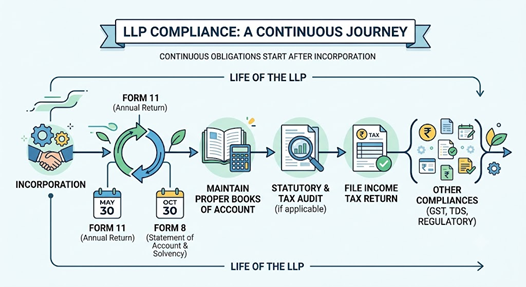
The key recurring MCA filings are Form 11 which is typically due on 30 May and Form 8 which is typically due on 30 October. The LLP also has to maintain proper books of account, ensure statutory and tax audit if required, file income tax return and comply with applicable GST, TDS and other regulatory compliances.
Partners, the LLP agreement and the registered office in case of change also need to be documented and notified within the timelines prescribed. The best way to handle these responsibilities is to keep accurate financial records, regularly review legal requirements, and use a compliance calendar that lists each filing, its due date and the responsible party.
A well-organised LLP compliance process helps to reduce avoidable costs, improve financial transparency and build a reliable foundation for sustainable business growth.
Disclaimer: This article is for educational purposes only and should not be considered legal, tax, or professional advice. Readers should consult a qualified Chartered Accountant, Company Secretary, or legal professional before taking any action.
Reviewed by CA Kishore A B, Chartered Accountant
Last Updated : 03rd November 2026